OKANAGAN SYILX HOMELANDS, WESTBANK B.C.—The BC First Nations Justice Council has launched a Police Accountability Unit (PAU) to assist Indigenous people affected by police violence, misconduct, or negligence, in B.C.
Responding to the disproportionate level of harmful police interactions experienced by Indigenous communities, the unit supports individuals navigating the complex system of police oversight processes, through free legal supports.
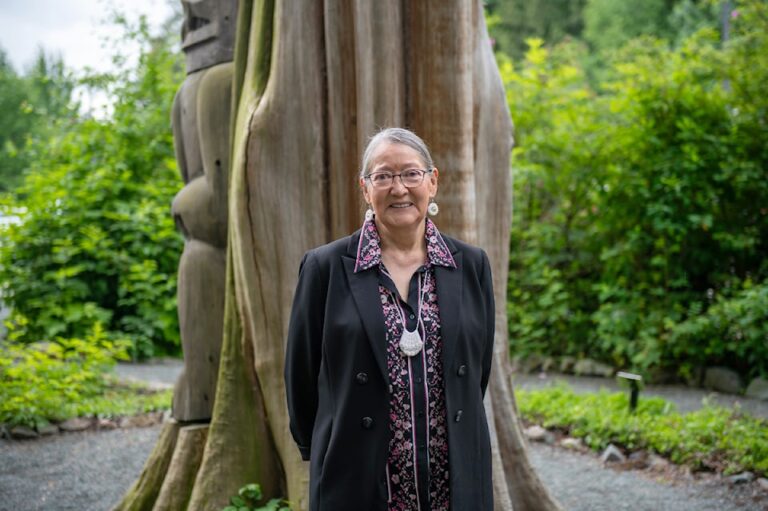
“When one of our community members or our children experiences police violence, we all feel it, and that doesn’t go away. The statistics are there and the pattern of violence and death has been documented time and again. The PAU is a step towards taking police oversight into our own hands on a provincial level. I am proud to share this service with First Nations and Indigenous communities across B.C. who have been asking for somewhere to turn, where they know they will be heard.”
—Cloy-e-iis (Dr. Judith Sayers), BCFNJC Director and Representative for Policing and Oversight, and the President of Nuu-chah-nulth Tribal Council.
The PAU first launched as a pilot project in 2024 in response to a direct ask from First Nations communities to establish the service. The PAU has since taken on over 220 files, demonstrating the need for the Indigenous-led accountability support—now an official BCFNJC service.
The PAU advances Strategy 7: Stronger Oversight and Accountability of the BC First Nations Justice Strategy, aligning with BCFNJC’s mandate to improve justice outcomes for Indigenous people in B.C. The PAU is an independent program funded by the Law Foundation of BC.
The unit’s staff lawyers provide comprehensive legal services ranging from summary advice, to filing police complaints, to pursuing civil actions in court, to filing complaints before tribunals like the Human Rights Tribunal. The PAU may take on cases related to municipal police forces, RCMP members, bylaw officers, and individuals in other law enforcement roles.
Accessing Services
Any Indigenous person affected by police action in B.C. can find more information and reach out to the PAU here.
Background
In 2024, nine Indigenous people were killed by police across Canada in a 20-day period (Aug. 29 – Sept. 18, 2024). This unbelievable statistic illuminated the deadly reality of police violence Indigenous families face every day.
In October 2024, several Indigenous and Black families gathered on Parliament Hill to demand action against police violence and its enduring impacts. Indigenous families from B.C. joined the call for a national public Inquiry into police-involved deaths of Indigenous people.
In December 2024, the Assembly of First Nations passed a resolution and called for a national inquiry into systemic racism in policing.
The BCAFN resolution stated that “despite 20 individual inquiries and commissions into the police and justice system since 1989, the federal government has failed to make substantive changes to address systemic racism within the RCMP and other agencies.”
BCFNJC launched the Police Accountability Unit as a pilot project that same year, in response to the longstanding issue of police violence and direct asks from community.
Quick facts
- As of May 2026, the PAU had 83 active files, 114 closed files, 27 files at various stages of the intake process.
- Among active files, 22 files (33%) involve municipal police departments, and 58 files (67%) involve RCMP.
- Among active files, 35 files (56%) involve use of force, eight files (21%) involve illegal arrest and detention, 11 files (21%) involve illegal search and seizure, and six files (10%) involve wellness checks (files addressing more than one element of misconduct or negligence, are included in multiple categories).
- Indigenous people are 10 times more likely than a white person in Canada to have been shot and killed by a police officer since 2017 (analysis).
- Indigenous people make up 5.1% of Canada’s population but 16.2% of the total number of police-involved deaths (read more).
- Strategy 7 of the BC First Nations Justice Strategy relates to advancing legislative and policy development to ensure there is a strong independent oversight and accountability function regarding the justice system and Indigenous people.
- BCFNJC’s legal and support services include: 16 Indigenous Justice Centres, one Indigenous Diversion Centre, Gladue Services, and the Police Accountability Unit.
About BCFNJC
BCFNJC represents the 204 First Nations in B.C. on justice-related issues and has been entrusted with the mandate to transform the justice system and create better outcomes for Indigenous people. Through the implementation of the BC First Nations Justice Strategy, BCFNJC is working to reform the current justice system and to support the rebuilding of Indigenous legal structures. Visit Tracking Justice for more information.
Media Contact
Mélanie Ritchot